
BLOG
What To Ask When Looking At Potential Homes
Buying a house can be an intimidating and overwhelming experience. Here are some key questions to ask yourself and sellers before plopping down a down payment. Let me help you with my FREE homebuyer's class! Call me today! Laura Key 310.866.8422

Buying a house can be an intimidating and overwhelming experience. Here are some key questions to ask yourself and sellers before plopping down a down payment.
What To Ask When Looking At Potential Homes
Following is a list of general questions you should always ask when considering making a real estate purchase. Keep in mind, however, you are unique.
You have particular dislikes and likes as well as factors in your life that are different than other people. The point I am trying to make is that you shouldn’t stick to just these questions. You are making an important choice, so give some thought to your situation.
1. Don’t rush into things. The first question to ask should be directed at yourself. What type of home do you want? How big should it be? What amenities do you want? Are you planning for a family in the next three to five years and will the home be able to accommodate a new bundle of joy? Make a definitive list and stick to it. If you stray from it, you could end up with a house that doesn’t really fit you and suffer buyer’s remorse.
2. The next question is what area do you want to live in? Pick a few. You may find the prices to be excessive or the selection not so hot, but make sure you exhaust those areas before moving on. Again, you want to avoid buyer’s remorse.
3. Once you start looking at homes, a key question to ask is how long the house has been on the market. The amount of time will give you an idea of how flexible the owner is on price. If the house has been on the market for a month, the owner isn’t going to be very flexible. If it has been on the market for six months, flexibility will definitely exist.
4. Has the house previously been in escrow, but fell out? If so, find out why? Was it a problem with the buyer getting financing or did the buyer find out there was something wrong with the home?
5. What kind of condition is the house in and how old is it? Remember that a seller has typically done everything reasonably possible to spruce up the home. If you can see wear and tear on the house, it may be a red flag. In such a situation, you need to get a home inspection to make sure there aren’t problems in areas you can’t see such as mold, rust and water leaks.
6. If you have children or are planning on it, you must investigate the school district. Are the schools good? Are there gangs or crime in the area?
7. In addition to the home price, you should ask whether there are any additional fees such association fees.
8. What are the property taxes and what will they be when you buy? Many people are shocked to find out how much they have to kick out in property taxes. Don’t get surprised.
9. Zoning and easement issues are often overlooked when buying a home. If you are buying in a neighborhood with many homes, zoning is undoubtedly going to be for residential living. Easements, however, can be nasty surprises. Find out if there are any easements on the property. An easement gives a third party the right to use of part of the property. This can include giving the neighbor the right to do something or a utility company to place structures on your prospective property.
10. Noise is another big issue to consider. If you are serious about the property, make sure to drive buy on weekdays and weekends. If the property shares a wall with another residence, such as a duplex or condo, make sure you view it while the neighbors are home to get an idea of how loud it is.
11. In the euphoria of buying a property, practical issues can be missed. A big one is traffic. Specifically, what is the commute like between the house and your place of work? You don’t want to buy the house only to find out it takes three hours to get to and from work each day.
Obviously, you should be asking many additional questions before making a purchase. These 11 questions, however, will help you get started. Call me to schedule a time to discuss the homebuying process in more detail. Don’t forget to look into fun things to do in the area to make sure it’s where you want to live!I care about my clients and educating them is a priority! Laura Key 310.866.8422 or email me at Laura.A.Key@gmail.com
What to Expect At a Foreclosure Auction
Whether you are an investor that would like to get into buying foreclosed homes for your personal use! Call me today! Laura Key 310.866.8422
Whether you are an investor that would like to get into buying foreclosed homes for your personal use or to flip the property or if you are having your home foreclosed on, you should know what to expect at a foreclosure auction. Of course, the actual steps that will be taken can vary a bit from state to state and from house to house, but it’s good to know what you will be getting into when you go to a foreclosure auction. Foreclosure auctions can be exciting, even fun, but knowing what to expect will help you make the most of the experience, whether you are an investor or a homeowner that is trying to get your house back.
Before the Auction
You’ll likely find out about the foreclosure auction in a local newspaper and on the flier may be information to pre-qualify for bidding. This will allow you to put down a deposit so that the auctioneer knows that you are a serious bidder and can fulfill your bid if you are the winning bidder. Being pre-qualified just sort of speeds up the process so that you don’t have to mess around with the deposit on the day of the auction. During this time you should also do some research on the house by looking into any liens that may be against the property, how much the property is worth, how much it has appreciated in the last few years, as well as property values in the area. If the home looks as though it will need some repairs, you should consider this as well when trying to come up with how much you will be willing to pay for the house. Without this research, no amount of knowledge about what goes on at a foreclosure option will help you because you won’t know where to start when it comes to actually making a good bid.
What Happens At the Auction
The auction will typically start with the auctioneer reading legal notices as well as a legal description of the property. The auctioneer will usually then begin taking bids on the property. If the auctioneer has pre-qualified bidders the process is more streamlined, if not, each time a bid is made the auctioneer will then ask for the bidders deposit check, which is typically right around $5,000 for residential auctions. After each bid the auctioneer will attempt to solicit bids for higher amounts. Each auction is different, but the auction increments usually are set by the auctioneer and may be by $100, $500, or $1,000 per bid. The auctioneer will continue to solicit bids by this increment until it is clear that the highest bid has been reached. Then, the auctioneer will announce, “Going once, going twice, three times, sold!” indicating that the auction is over and the property has been sold to the highest bidder.
Once the bidding has ended a foreclosure deed and purchase papers will be drawn up and validated by the new owner or purchaser and the mortgage holder. A grace will likely be given to allow the purchaser to find financing or to come up with the funds to cover the full amount of the bid. This grace period is usually 30 days unless the purchaser and the mortgage holder agree to other terms. After the grace period a closing will take place, so that the new owner can formally take the title to the property.
What Happens, Now?
The purchaser can do what he or she intended to do with the property, whether it is to move into the home or to sell it for full market value. The money paid by the purchaser will be distributed in order of priority, first of which would be taxes. After taxes money will be paid to the mortgage, then the second and third mortgage if applicable. If there is still money after paying these debts, remaining money will be paid to lien holders and creditors. There is a very slim chance that there will be money left over after all of the debts are paid, if this is the case then the monies will be paid to the former home owner.
What about the Original Owner?
The original owner will often be at the auction so that they can bid on their home, and this is legal as long as they have the deposit required. If the owner of the home that has been foreclosed does bid on the home they must remember that the deposit is not refundable and the deposit assumes that they will be able to finance the home within the grace period. Owners must also remember that if they buy the property back old debts may merge and become reinstated such as second and third mortgages that became void when the first mortgage foreclosed on the property unless one has filed bankruptcy and is truly free and clear of these debts. Owners will often drum up the funds to make the deposit so that they can have another 30 days to try to save their home. Owners may or may not be successful in their attempts to save their home at a foreclosure auction.
As you can see, there are a lot of things that go into a foreclosure auction, but none of them are all that difficult to understand, but knowing about them makes the auction more enjoyable. The auction itself is not all that complicated, but it can be very fast paced. At some foreclosure auctions there are a lot of people, at others there are only a few because of the location or just the debts attached to the property, or even the state of the property. If you are serious about the property you should pay close attention when bidding starts so that you are sure that you can get your bid in when you feel it’s time so that you have the best chance of being the top bidder.
Call me for more info! Laura Key 310.866.8422
4 Steps To Real Estate Investing Success!
Real estate investing is always good and sometimes it's red hot. When it's hot dozens of real estate seminars begin rolling across the country and thousands of people spend thousands of dollars for investing education. One good resource is to have an Agent who is Investor friendly! Call me and let's chat! Laura Key 310.866.8422

Real estate investing is always good and sometimes it's red hot. When it's hot dozens of real estate seminars begin rolling across the country and thousands of people spend thousands of dollars for investing education.
It's startling to learn that of all those thousands of eager folks who attend these seminars only about 5% buy even one investment house. Why? The real estate gurus sell the "sizzle" and make profiting from real estate sound easy. The truth is that it's simple, but not easy.
Here's a quick plan that will enable anyone to begin building financial independence.
There are basically four steps to investing in single family homes:
1. Buy homes below full market value. Yes, people really do sell homes for less than the home's full value. The key is to understand that most home owners will only consider a purchase offer that is all cash and within 5% to 10% of their asking price.
The successful investor learns to find financially distressed home owners who have no choice but to sell for less than market value. They have lost their job or been suddenly transferred; they are divorcing; they been living beyond their income; the family has been overwhelmed with medical bills and, not uncommonly these days, their money has gone to support a drug habit.
Those are examples of motivated sellers. They have to sell and they will accept something other than a conventional, all cash offer.
2. How do you find motivated sellers? You work at it! Like any business it is important to develop a little marketing plan. One that is simple, yet very effective, is the one that was proven 75 years ago by the Fuller Brush company; door to door sales.
You are selling your skill as a home buyer to people who must sell. Your are there when they need you and you have the skill to help them solve at least part of their problem. With door to door prospecting you will learn more and buy more homes quicker than any other method. However, most people just won't walk door to door for three or four hours per week. OK, there are other ways.
You can watch public notices for the announcement of foreclosure sales. Meeting with a home owner right after they've received a notice that they are about to lose their home allows you to deal with a very motivated seller. Other public notices that provide buying opportunities include probate, divorce and bankruptcy. You can follow the Homes For Sale listings in your local newspaper or Internet site.
You can telephone the names found in these notices or, and this is the least time consuming, send a postcard expressing your interest in buying their property. It will produce buying opportunities, just not as many as personal contact.
3. After you've found a motivated seller you must understand how to frame offers that provide benefits for both you and for the home owner. A good real estate investor quickly learns that this is not a business of stealing property, but of solving problems in a way that benefits the seller.
The home owner is in a tight spot of some kind and you can save them from public embarrassment and, in most cases, give them at least a little cash to get a new start.
No investor can afford to leave cash in every deal. No one but Bill Gates has that much available money. You must use creative techniques like, leases, option and taking over mortgage payments. Little or no cash is needed for those deals. You can find plenty of reasonable priced educational material on those subjects in book stores or on EBay. The same education that seminars sell for thousands of dollars.
4. You make your profit when you buy! Never make a purchase until you've carefully determined exactly how you will get to your profit. If you hold it as a long term investment will the monthly rental income more than cover the monthly mortgage payment? Will you sell the deal to another investor for fast cash? Will you do some fix-up and sell the property for full value? Will you quickly trade it for a more desirable property? Have a plan before you buy.
There you have four steps that even a part-time investor can execute in three to four hours per week. What's the missing ingredient? Your determination and perseverance. If you will unfailingly follow the plan for a few months you will be well on your way to financial independence.
CALL ME TODAY TO HELP BUILD YOUR PORTFOLIO! Laura Key 310.866.8422
3 Ways Renters Lose Money
Are you still renting a home or apartment for yourself or your family? If so, you're losing money. Besides losing out on making money with real estate, renters don't get the same satisfaction of home enjoyment that benefits home buyers. If you're renting, call me today to find out how to to buy your own home. Call me today! Laura Key 310.866.8422
Are you still renting a home or apartment for yourself or your family?
If so, you're losing money. Think about these three ways you lose money by renting:
1. You're paying for someone else's mortgage payment. You're missing out on the appreciation that the property gives to the landlord. Appreciation is a term used in accounting relating to the increase in value of an asset, which means in real estate terms, added value to the property. Over the past five years, houses appreciated significantly, making many new real estate investor multimillionaires.
2. Renters don't get to freeze their monthly housing expenses like home buyers can. Of course, many home buyers get mortgage payments with adjustable interest rates and their payments go up over time. However, these payments will not go up over the long term like rising rents. Just think about how much an apartment costs today compared to ten years ago. A two bedroom apartment in Lake Elsinore, California leases for $1,000 today. The exact same apartment rented for $325 in 1996, when it was brand new. Home buyers who had low monthly payments in 1996, who did not refinance their mortgage, enjoy low payments and don't have to worry about rising rents.
3. Renters don't benefit from tax advantages. Home owners get income tax deductions. Tax deductions for interest costs, for instance, save tax payers thousands of dollars.
Emotional Satisfaction of Home Ownership
Besides losing out on making money with real estate, renters don't get the same satisfaction of home enjoyment that benefits home buyers. Many landlords won't allow you to paint your walls in colors that you desire. Also, you won't feel like fixing up the property with custom window coverings and you get little say in flooring materials. Because you can't make your personal statement, you won't feel like you're HOME as much as home owners who feel emotionally connected to their property.
How to Buy Your First Home
The biggest barrier to home ownership is often accumulating funds for a down payment. People think they have to have thousands of dollars for a down payment. However, if you have good credit and a decent job, you can get a mortgage for a home with zero down. And you can finance some of your closing costs as well as ask the seller to help you pay a good portion of your purchase costs. With today's mortgage finance plans, you may be surprised to find out how much of a home you can afford with payments similar to what you currently pay in rent.
You may have to go out of the major metropolitan areas to buy a home. That's why so many people commute in Southern California. Affordable housing costs much less in outlying areas. But so do the rents. If you're renting an apartment for $2,300 in Los Angeles, you could buy a $500,000 home in Wildomar. Our daughter just purchased a home in December 2005 and her mortgage payment, for a 3,000 square foot new home, costs less than $2,300. With her tax savings, she will pay even less than renting a small apartment closer to downtown L A.
If these amounts sound high to you, check your local area. Perhaps your monthly rent is only $1,000 and houses cost less than $200,000. Talk to a mortgage loan officer and see how much of a home you can afford.
If you're renting, make one of your priorities to buy your own home.
Copyright © 2006 Jeanette J. Fisher
What is the Difference Between the Note and Deed of Trust
It's important to know the basics of real estate if you are going to own a home! Call me to register for a FREE Homebuyers Course! Laura Key 310.866.8422

A note, usually known as a promissory note, which is a written promise to repay a loan. Whereas, a trust deed is a document used to protect paying back of a loan that is being documented as a lien counter to the borrower's real estate. It is necessary to use a promissory note in order to avoid any breach in future. The various important terms of the loan should be specified in a promissory note including the loan amount, rate of interest (if any), and terms and conditions of repayment. It must be signed by the borrower with date in order to make it a valid document.
A deed of trust is a document that involves three parties generally known as the borrower, lender and a trustee. This document includes all the basic terms of the loan and should be signed by the borrower. It is documented as a lien contrary to the borrower's real estate. It is generally taken as a collateral document that works consecutively with the promissory note. In this document, the real property of the borrower is guaranteed as a lien to the lender. In case, the borrower is not able to pay back the loan amount, the lender may take the borrower's real property by way of the system of foreclosure.
A promissory note is a legal document that laid out all the essential things like how and when the borrower will pay back the money to a lender, the interest rate and the schedule of payment. It contains the undertaking of the borrower to repay the borrowed money within the specified time period. It is the personal obligation of the borrower to repay the money and has no relationship with an y real estate or other property.
Therefore, it can be understood that although, both the Note and Deed of Trust are an agreement for repayment of a loan, the tow are independent elements of a common mortgage loan. A deed offers the lien on the property in order to secure repayment of the loan. And, the note is completely a commitment between the borrower and the lender. The terms of this agreement can be modified at any period of time with the consent of both the parties. The deed of trust appears in the public property records, whereas, the note is completely a private document that never appears in the public records and therefore it is administratively very easy to make any modifications in the note.
*Please note that the information contained herein is for general informational purposes only. If you are currently involved in a real estate transaction, please direct your questions to your real estate professional, title officer or closing officer.
Rising Housing Demand Leads to Homebuilder Lotteries
In California the inventory is extremely low. My buyers see this an an option! I hate that it's come to this! Just a year ago you did not have this issue!
Short sales show up on credit reports as foreclosure, sellers unable to get back in housing market
It is critical that your Real Estate Agent know what to look for in your short sale approval letter! Make sure you work with an experienced short sale agent! Call me today with questions! Laura Key 310.866.8422

More and more short sales are turning up as foreclosures on credit reports. The issue caught the attention of Senator Bill Nelson who this week asked for a federal investigation into why the mortgage industry does not have a separate credit reporting code for short sales.
Like some of his Trinity neighbors, George Albright unloaded his underwater two-story thru a short sale. A short sale damages credit versus a foreclosure that slashes consumer scores.
It's been more than two years since Albright sold his home, and now's he ready to buy again, but can't. It’s showing up as a foreclosure on his credit.
Veteran mortgage broker Pam Marron found it's a scenario repeating itself over and over again. Short sellers discover they can't get back into the housing market because their credit report shows a foreclosure.
Why? The banks and credit bureaus have no special code to report a short sale, according to Marron, who recently traveled to D.C. to educate lawmakers and lobby groups like the Consumer Protection Bureau to do something about the glitch that could affect many.
Experian says the problem is not theirs. In an email, a spokesperson explained. "The short sales and foreclosures are being coded correctly on Experian’s credit reports. Where we have found the discrepancies occurring is in the underwriting process."
Short term, Marron says, short sellers must demand a letter from their lender that states that the property closed is a short sale and any marking of a foreclosure should be deleted.
Source: www.ABCActionNews.com By: Jackie Callaway
Homebuyers clueless about mortgages
Educating homebuyers is one of my favorite things to do! Ask me about my homebuyers class! Laura Key 310.866.8422

The housing market is heating up, yet many house hunters are not prepared to take on the biggest purchases of their lives.
When it comes to mortgages, homebuyers answered basic questions about terms, how to choose a lender and financing wrong nearly one-third of the time, according to an April survey of more than 1,000 current and prospective homeowners by real estate website Zillow.
Among the survey's findings, 31% of buyers don't think it's possible to get a mortgage for less than 5% down; 34% don't know what the term "annual percentage rate" (APR) means and one in four believe you must close with the lender that pre-approves your mortgage.
"All too often buyers focus on negotiating a lower home price and ignore the importance of finding the right loan," said Erin Lantz, director of mortgages for Zillow. "Buyers should always shop multiple lenders and compare rates and fees and read lender reviews in order to find the best loan for their situation."
One example: 34% of respondents believe lenders are required by law to charge the same fees to all clients for credit reports, appraisals and the like. That's wrong. Fees vary from bank to bank and can often be negotiated.
But it's hard to compare those deals if you don't understand what mortgage terms, like "annual percentage rate," mean. The APR factors into fees, upfront points, origination and underwriting fees and other costs that borrowers use to compare the actual cost of loans.
Such knowledge gaps can have long-term consequences. About 34% of first-time homebuyers think they need a down payment of at least 5% to make a home purchase, but loans insured by the Federal Housing Administration can require as little as 3.5% down.
And 24% of buyers believe the best mortgage deals are available through the banks where they currently have their savings and checking accounts, but often competing lenders can undercut those banks by large margins.
"If a homebuyer can lower their interest rate by even half a percentage point, they can not only increase their purchasing power, but save thousands of dollars over the life of the loan," said Lantz.
For every $100,000 borrowed, a half percentage point lower rate would reduce payments by $28 a month on a 30-year, fixed rate loan. That adds up to more than $10,000 over 30 years. Or borrowers could choose to add that $28 savings to each monthly payment. That would shorten the term of the mortgage from 30 years to just over 27 and save $6,500 in interest paid.
Another costly mistake: Many house hunters go shopping with financing in place because it enables them to act more quickly if they see a home they want. But 26% of buyers believe that once they're pre-approved, they're obligated to close the deal with those loans, according to the survey. In reality, there's no obligation. If buyers see better terms available they should take them.
Existing homeowners can also be guilty of ignorance. Some 20% of homeowners surveyed didn't know that underwater mortgages -- those in which borrowers owe more than their homes are worth -- can be refinanced into lower rate loans.
Finally, the survey found that nearly a third of homeowners are unaware that if they go through a foreclosure or short sale, they may not have to wait the full seven years it takes for their credit score to recover and they can buy a home again.
In reality, some homeowners who do short sales can obtain financing to buy another home in as little as two years.
The Consumer Financial Protection Bureau is hoping to make it easier for homebuyers with simplified mortgage forms that help them compare terms and costs and by creating new rules that will protect homeowners from getting into loans they can't afford.
Free home search here! Click the house to begin!

Source: By Les Christie @CNNMoney May 9, 2013
Definition of Prescriptive Easement
Call me if you have some questions about a Prescriptive Easement! I have a team that can help you if you have concerns! Laura Key 310.866.8422
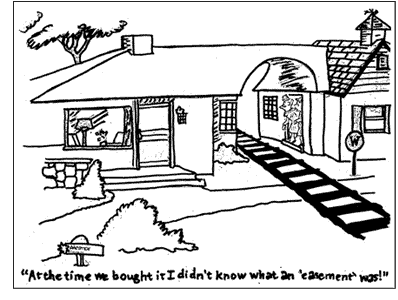
A prescriptive easement creates a right to use another's land for a specific purpose. The easement is created by making use of the land without owner permission for a period of time specified by statute. Interference with a prescriptive easement gives the easement holder cause to bring suit.
Easement in General An easement creates a right to use land that is possessed by another for a specific purpose. One parcel of land, the "dominant tenement," enjoys the benefit of the easement, while the "servient tenement" is the land being used for the easement purpose. Once an easement is validly created, even if not used, it is presumed to be perpetual.
Prescriptive Easement A prescriptive easement is acquired when the servient tenement is used for a specific purpose, for some time without the permission of the owner. Through the continuous use and the owner's failure to stop it, the dominant tenement can acquire the right to use the servient tenement property indefinitely. A prescriptive easement is a type of easement appurtenant, meaning that the holder receives physical use or enjoyment of the property. All who may succeed to title of the dominant tenement will be entitled to the prescriptive easement; the easement need not be mentioned in the conveyance or deed in order to be operative.
Elements Speaking generally, for legal elements are usually required: adverse use (use of the servient property without permission of the owner); open and notorious use (with no attempt at concealment); continuous use for the entire statutory period (required statutory periods vary among states, but the minimum is five years); and hostility, meaning that hte easement user knowes he has no right to use the property. However, individual state' easement laws may display variations, and those with easement issues should consult a legal professional.
Exclusive Use Jurisdictions are split on weather a prescriptive easement requires that adverse use of the property be exclusive in order to fulfill the legal element. A minority of jurisdictions will not allow a prescriptive easement if other parties besides the dominant tenement have also been using the servient tenement adversely for the same use. However, most do not require exclusive use, only that the dominant tenement's right to adversely use the easement "does not depend on a like right in others". In other words, the dominant tenement may still get the prescriptive easement even if the owner or others are also using the tenement in a similar manner.
Termination of Easement As an owner may prevent establishment of a prescriptive easement by effectively ending the dominant tenements adverse use; this can be accomplished by bring suit or physically ejecting the easement user from the property. Easements can also be terminated in several ways; the easement holder can release the servient tenement from the easement; the dominant and servient tenement can merge ownership; or the servient tenement can be condemned. The servient tenement may also invalidate the easement by a sort of "reverse prescription," if the servient tenement uses the easement for a long time and the easement holder "sleeps on his rights."
Source: http://www.ehow.com/about_6501555_definition-prescriptive-easement.html
Despite Improvement in Loan-Mod Defaults, Report Raises Alarms
Sadly, loan modifications have not been very successful. Have you had your modification denied? Call me - Laura Key 310.866.8422
There are few defenders of the Obama administration’s signature loan-modification initiative, the Home Affordable Modification Program, or HAMP. But a new report released on Wednesday raised an interesting criticism of HAMP—that borrowers aren’t staying current on modified payments even though HAMP has reduced, on average, borrowers’ monthly payments by more than $400.
The report, from the special inspector general for the Troubled Asset Relief Program, or Sigtarp, said there was an “alarming rate” of homeowners who were defaulting after receiving a permanent mortgage modification.
The report says data show that the longer a homeowner remains in HAMP, the more likely he or she is to redefault out of the program. This is true of almost any mortgage-modification program.
But the report raises broader questions about whether mortgage modifications have been worth the costs, and against what yard stick success in any such program should be measured.
There are plenty of faults to find with HAMP. Officials struggled to ensure taxpayer money wasn’t wasted, so they required lots of documentation. That created new headaches: banks rejected borrowers that they said provided incomplete forms, while borrowers routinely complained that banks lost their paperwork. In an interview last year, Shaun Donovan, the housing secretary, said it was a “fair criticism that programs initially were too complicated and had too many restrictions.”
Mortgage servicers were also overwhelmed. During tense meetings at the Treasury Department throughout 2009 and 2010, officials laid into the banks for not staffing up. Executives groused that HAMP rules changed so often that they couldn’t keep up and that new headline-grabbing initiatives were announced before they could be rolled out to be offered to borrowers.
Others said HAMP didn’t do enough to deal with negative equity, which prompted the administration to launch a belated effort two years ago to encourage principal reduction. The Treasury never made it mandatory because they feared it would both be too expensive and that it would lead banks to opt out of HAMP.
Under HAMP, banks received modest incentive payments to reduce borrowers’ monthly payments to around 31% of their current income, often by extending the loan term and dropping the interest rate. Modifications have resulted in an average monthly payment reduction of $545 or $400, depending on which type of modification lenders provide under the program.
So far, around 860,000 borrowers have active HAMP modifications, and around 290,000 have fallen out of the program. The Sigtarp report said it was “alarming” that 46% of a few thousand permanent modifications made in the third quarter of 2009 had redefaulted, as well as 39% of those made in the last quarter of 2009.
But some industry executives have said that, for all its faults, HAMP succeeded in giving the industry a template for a more sustainable loan modification. Before 2009, many modifications didn’t result in lower monthly payments, and mortgage modifications in the post-HAMP world have performed drastically better than those that came before. Around 25% of borrowers who received a modification in 2011 had fallen behind on payments within one year, down from 57% in 2008, according to banking regulators.
Moreover, more recent HAMP modifications are performing significantly better than earlier HAMP “mods,” something that may be owed to an improving economy as much as any program improvements. Around 11% of HAMP modifications made in late 2011 had defaulted after one year, compared with more than 20% for those made when the program launched in mid-2009.
Data also show that HAMP modifications, which typically offer the most generous payment relief, perform better than privately issued modifications.
Among the bigger questions raised by the report: If mortgage modification redefault rates under HAMP are too high, what’s an acceptable level? And can any mortgage modification program hit those targets?
Source: Wall Street Journal
First comes home, then comes marriage?

Couples today are significantly more likely to purchase a home before marrying than older couples were, according to a survey commissioned by real estate franchisor Coldwell Banker that appears to point to a cultural shift in views toward homeownership and marriage.
Twenty-five percent of married couples between the ages of 18 and 35 bought their first home before their wedding date, compared to 14 percent of married couples who are 45 or older, according to the survey, which was administered by Harris Interactive on behalf of Coldwell Banker.
"While life goals and expectations continue to weigh on young couples, their views of homeownership are transcending their plans of marriage and starting a family, creating a direct effect on the patterns of buying a home altogether," said Dr. Robi Ludwig, Coldwell Banker's lifestyle correspondent. "What we're seeing is that young couples are switching up the order and purchasing their first home regardless of whether or not they have set a wedding date. This is a huge movement within the American culture. While younger generations may be focusing more on their career, and in turn waiting longer to get married and have children, they are not delaying their dream of homeownership."
Other findings of the study include:
- Eighty percent of homeowners surveyed said buying a home strengthened their relationship more than any other purchase.
- Thirty-five percent of married homeowners purchased their first home by their second anniversary.
- Ninety-three percent of homeowners who purchased their first home while married always planned on buying a home after marrying.
- Thirty-five percent of married homeowners wish they had bought a home earlier than they did.
Is your big day coming up! Time to settle into a nest! Call me today! Laura Key 310.866.8422
BY INMAN NEWS, MONDAY, APRIL 22, 2013. Inman News®
Does HUD Offer Special Programs for Homebuyers?
Buying a HUD Home is not as difficult as you may think! I have helped many people purchase their 1st Home from HUD! Call me today for more details about the process! Laura.A.Key@gmail.com or Visit my website to sign up for FREE HUD Listings! http://www.KeyCaliforniaHomes.com

Yes, HUD offers a program called the GOOD NEIGHBOR NEXT DOOR PROGRAM for Police Officers, Firefighters, EMT and Teachers! Call for more details on this program! 310.866.8422. If foreclosures are not sold within six months, HUD will sell them for $1 each to approved nonprofit organizations and government agencies. Homes must then be used create housing for families in need or to benefit neighborhoods.
Los Angeles HUD homes, Buying A Hud Home, North Hollywood HUD homes, Westchester HUD Homes, Gardena HUD Homes, Northridge HUD Homes, Santa Clarita HUD Homes, Simi Valley HUD homes, Lemert HUD Homes, Compton HUD Homes, Lynwood HUD Homes, Hawthorne HUD Homes, Inglewood HUD Homes, Baldwin Hills HUD Homes, Playa del rey HUD homes, Marina del Rey HUD Homes, Santa Monica HUD homes, Lakewood HUD homes, Buying A HUD Home, Buying a Los Angeles HUD Home, HUD Trained Agent, HUD NAID agent, Good Neighbor Next Door
Does HUD Offer Financing On Their Homes?
Buying a HUD Home is not as difficult as you may think! I have helped many people purchase their 1st Home from HUD! Call me today for more details about the process! Laura.A.Key@gmail.com or Visit my website to sign up for FREE HUD Listings! http://www.KeyCaliforniaHomes.com
HUD does not provide direct financing to buyers of HUD Homes. Buyers must obtain financing through either their own cash reserves or a mortgage lender. If you have the necessary available cash or can qualify for a loan (subject to certain restrictions) you may buy a HUD Home. While HUD does not provide direct financing for the purchase of a HUD Home, it may be possible for you to qualify for an FHA-insured mortgage to finance the purchase.
Los Angeles HUD homes, Buying A Hud Home, North Hollywood HUD homes, Westchester HUD Homes, Gardena HUD Homes, Northridge HUD Homes, Santa Clarita HUD Homes, Simi Valley HUD homes, Lemert HUD Homes, Compton HUD Homes, Lynwood HUD Homes, Hawthorne HUD Homes, Inglewood HUD Homes, Baldwin Hills HUD Homes, Playa del rey HUD homes, Marina del Rey HUD Homes, Santa Monica HUD homes, Lakewood HUD homes, Buying A HUD Home, Buying a Los Angeles HUD Home, HUD Trained Agent, HUD NAID agent
HUD-Owned Homes Expected to Surge
Soon the market will be filled with new listings from HUD! Are you prepared? Make sure you use an agent who is HUD experienced and can help you find the home of your dreams. I have closed many HUD homes in the past few years! Let me assist you! Laura Key 310.866.8422

The U.S. Department of Housing and Urban Development is reportedly going to be releasing more of its homes to the market, which could be welcome news to buyers who have faced slim pickings in for-sale inventories.
Over the next two years, experts predict that HUD homes on the market will increase significantly as lenders work through the backlogs of foreclosures and foreclosure reviews.
“The inventory is there, [it’s] just not being released during the banks/servicers review of the loan/mortgage documents,” says Nat Genis, a HUD listing broker in Riverside County, Calif., which is already seeing an increase in HUD-owned homes.
"HUD homes are back," Genis told HousingWire. "FHA financing went away with the 'creative' financing of the 80/20 loans, and now with the increase of FHA financing, these government-backed loans guarantee that if the borrower defaults, HUD will pay off the mortgage, obtain the deed, and re-sell the home."
HUD-owned homes can be appealing because of the discounted sales price, even though they can be in poor condition often times, HousingWire reports.
HUD had 39,442 homes in its REO inventory nationwide as of Feb. 28, 2013—with 20,536 of those having pending contracts on them, according to HUD.
Source: “HUD homes add to inventory-starved market,” HousingWire (April 29, 2013)
Do I Need An Appraisal On A HUD Home?
Buying a HUD Home is not as difficult as you may think! I have helped many people purchase their 1st Home from HUD! Call me today for more details about the process! Laura.A.Key@gmail.com or Visit my website to sign up for FREE HUD Listings! http://www.KeyCaliforniaHomes.com
It is not necessary to have a HUD home independently appraised, HUD offers an appraisal every 6 months. Your Lender may require a more current appraisal than the one provided by HUD. Ask your loan officer or HUD registered agent.
Los Angeles HUD homes, Buying A Hud Home, North Hollywood HUD homes, Westchester HUD Homes, Gardena HUD Homes, Northridge HUD Homes, Santa Clarita HUD Homes, Simi Valley HUD homes, Lemert HUD Homes, Compton HUD Homes, Lynwood HUD Homes, Hawthorne HUD Homes, Inglewood HUD Homes, Baldwin Hills HUD Homes, Playa del rey HUD homes, Marina del Rey HUD Homes, Santa Monica HUD homes, Lakewood HUD homes, Buying A HUD Home, Buying a Los Angeles HUD Home, HUD Trained Agent, HUD NAID agent
How Much Money Will I Have to Put Down on a HUD Home?
Buying a HUD Home is not as difficult as you may think! I have helped many people purchase their 1st Home from HUD! Call me today for more details about the process! Laura.A.Key@gmail.com or Visit my website to sign up for FREE HUD Listings! http://www.KeyCaliforniaHomes.com
If the bid price is less than $50,000, you’re required to make an earnest money deposit of $500. HUD homes priced greater than $50,000 require a $1000 deposit.
Los Angeles HUD homes, Buying A Hud Home, North Hollywood HUD homes, Westchester HUD Homes, Gardena HUD Homes, Northridge HUD Homes, Santa Clarita HUD Homes, Simi Valley HUD homes, Lemert HUD Homes, Compton HUD Homes, Lynwood HUD Homes, Hawthorne HUD Homes, Inglewood HUD Homes, Baldwin Hills HUD Homes, Playa del rey HUD homes, Marina del Rey HUD Homes, Santa Monica HUD homes, Lakewood HUD homes, Buying A HUD Home, Buying a Los Angeles HUD Home, HUD Trained Agent, HUD NAID agent
Can You Buy a Home That Isn’t for Sale?
With inventory so low in Cali you must think outside the box. I'm willing to go there with you! Laura.A.Key@gmail.com

It may seem like an odd question, but apparently, you can!
This article is brought to you exclusively by RealtyPin.com
Should I Get A Home Inspection If I Am Buying A HUD?
Buying a HUD Home is not as difficult as you may think! I have helped many people purchase their 1st Home from HUD! Call me today for more details about the process! Laura.A.Key@gmail.com or Visit my website to sign up for FREE HUD Listings! http://www.KeyCaliforniaHomes.com
HUD does not warrant the condition of its properties and will not pay for the correction of defects or repairs. Since the new owner will be responsible for making needed repairs, HUD strongly urges every potential homebuyer to get a professional inspection prior to submitting an offer to purchase.
If you are interested in acquiring a HUD Home that is in need of repair, you may be interested in applying for an FHA 203(k) Rehabilitation Loan. When a homebuyer wants to purchase a house in need of repair or modernization, the homebuyer usually has to obtain financing first to purchase the dwelling; additional financing to do the rehabilitation construction; and a permanent mortgage when the work is completed to pay off the interim loans with a permanent mortgage. Often the interim financing (the acquisition and construction loans) involves relatively high interest rates and short amortization periods. The Section 203(k) program was designed to address this situation. The borrower can get just one mortgage loan, at a long-term fixed (or adjustable) rate, to finance both the acquisition and the rehabilitation of the property.
Will HUD make the repairs?
HUD homes are sold as-is. The new owner is responsible for all repairs and improvements.
Can I start improving on the property right away?
If HUD accepts your offer, you cannot make any repairs or home improvements until the escrow transaction has closed and title is recorded in your name.
Los Angeles HUD homes, Buying A Hud Home, North Hollywood HUD homes, Westchester HUD Homes, Gardena HUD Homes, Northridge HUD Homes, Santa Clarita HUD Homes, Simi Valley HUD homes, Lemert HUD Homes, Compton HUD Homes, Lynwood HUD Homes, Hawthorne HUD Homes, Inglewood HUD Homes, Baldwin Hills HUD Homes, Playa del rey HUD homes, Marina del Rey HUD Homes, Santa Monica HUD homes, Lakewood HUD homes, Buying A HUD Home, Buying a Los Angeles HUD Home, HUD Trained Agent, HUD NAID agent
Is There Anyway To Have My HUD Offer Considered Before Others?
Buying a HUD Home is not as difficult as you may think! I have helped many people purchase their 1st Home from HUD! Call me today for more details about the process! Laura.A.Key@gmail.com or Visit my website to sign up for FREE HUD Listings! http://www.KeyCaliforniaHomes.com

Owner occupants always have first priority; however, if there are not any bids after the 30th day then bidding is open to all bidders (investors). All offers are due by the bidding date and the HUD system generally picks the highest and best offer.
Los Angeles HUD homes, Buying A Hud Home, North Hollywood HUD homes, Westchester HUD Homes, Gardena HUD Homes, Northridge HUD Homes, Santa Clarita HUD Homes, Simi Valley HUD homes, Lemert HUD Homes, Compton HUD Homes, Lynwood HUD Homes, Hawthorne HUD Homes, Inglewood HUD Homes, Baldwin Hills HUD Homes, Playa del rey HUD homes, Marina del Rey HUD Homes, Santa Monica HUD homes, Lakewood HUD homes, Buying A HUD Home, Buying a Los Angeles HUD Home, HUD Trained Agent, HUD NAID agent
White House Rolls Out 3 Foreclosure Prevention Efforts
Even though the market has become of hot bed in these last few months. There are still homeowners struggling to keep their homes. Here are some new programs that may help. Are YOU facing foreclosure? Call me! Laura Key 310.866.8422
The Obama administration announced the extension or debut of three programs aimed at helping distressed home owners avoid foreclosure. The three initiatives are:
Increasing outreach in the Making Home Affordable Program: The U.S. Department of Treasury is partnering with NeighborWorks America as well as the National Foreclosure Mitigation Counseling program to increase support for struggling home owners who seek assistance through the Making Home Affordable Program, which includes the Home Affordable Modification Program (HAMP). HAMP reduces monthly payments by more than $540 each month, on average. “Through the new initiative, housing counseling agencies will help struggling home owners successfully complete and submit application documents to their mortgage company free-of-charge,” according to the White House blog.
Informing the unemployed about programs: The Department of Labor will be encouraging American Job Centers to inform unemployed home owners about federal foreclosure prevention options that are available to them. For example, there is unemployment forbearance through HAMP that allows qualifying home owners who are unemployed to reduce or suspend their mortgage payments for up to 12 months.
HUD’s new Housing Counseling Office: The Department of Housing and Urban Development has launched a Housing Counseling Office, which offers at-risk home owners free or low cost information about foreclosure prevention and loan modification programs. It also offers general information on buying or renting a home, handling foreclosures, and how to avoid scams. The office is made up of a network of 2,500 HUD-approved housing counseling agencies.
“While we are encouraged that the housing market is on the path to recovery, our job is far from finished,” according to the White House blog. “There are still many struggling home owners who need assistance. By connecting eligible home owners with existing foreclosure prevention programs, our new counseling initiatives will enable more borrowers to remain in their homes and go a long way in ensuring a brighter economic future for these families.”
Source: The White House Blog